
Understanding the difference between percentage and percentile is crucial for students, test-takers, and professionals alike. These two terms are often used interchangeably in casual conversation, but they represent fundamentally different concepts in statistics and academic assessment. Confusing one for the other can lead to serious misunderstandings about exam results, competitive rankings, and performance evaluations.
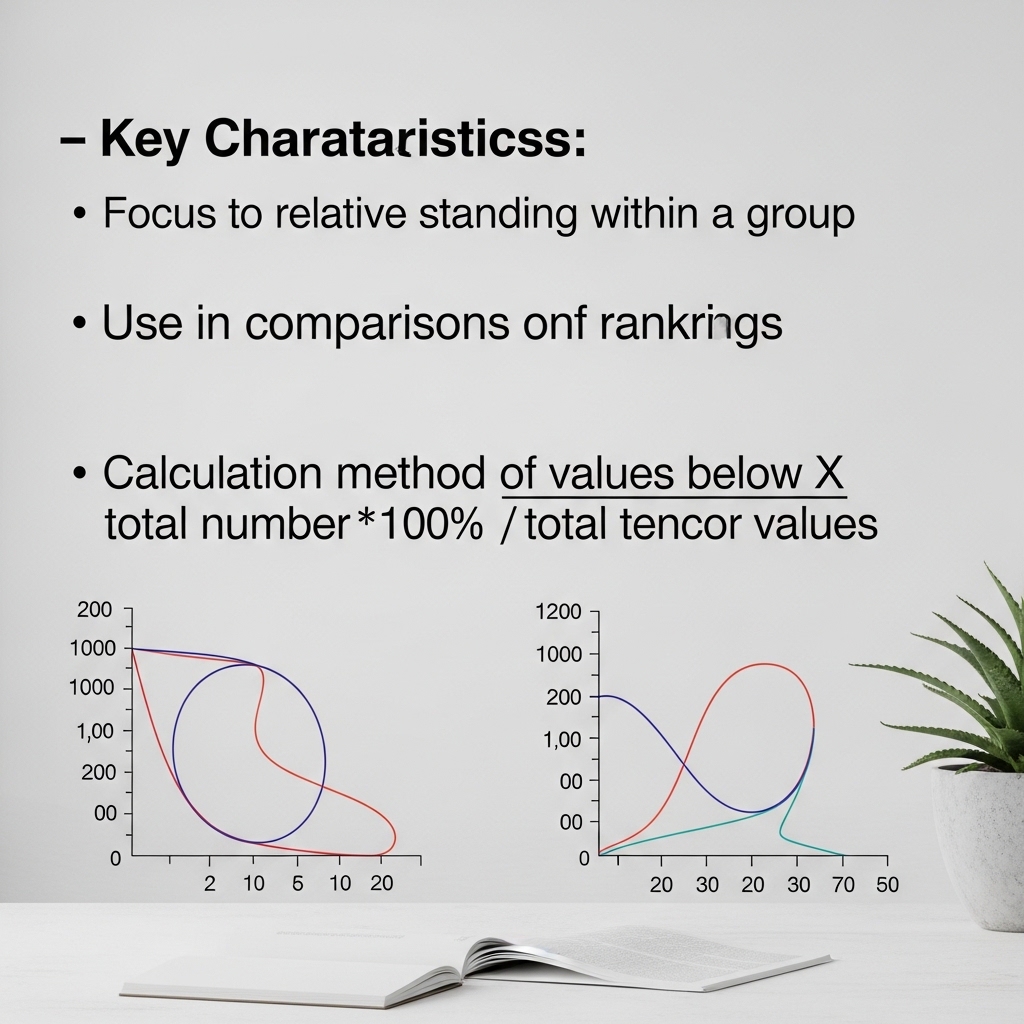
Percentage is a simple mathematical concept that expresses a number as a fraction of 100. It answers the question: “How many out of 100 did I get right?” Percentile, on the other hand, is a statistical measure that indicates the relative standing of a value within a larger dataset. It answers the question: “What percentage of people scored below me?”
This distinction becomes critically important in high-stakes situations like competitive exams, standardized testing, job aptitude tests, and academic admissions. A student might score 80% on an exam, which sounds excellent. But if that 80% falls at the 60th percentile, it means 40% of test-takers scored higher. Conversely, a score of 65% might be at the 90th percentile if the exam was exceptionally difficult.
In this comprehensive guide, you will learn exactly what percentage and percentile mean, how to calculate each one, and when to use which measure. You will discover real-world examples from exams like the SAT, GRE, CAT, and NEET, where percentiles often matter more than raw percentages. By the end, you will never confuse these two terms again and will be able to interpret your own scores with professional confidence.
What Is Percentage and How Is It Calculated?
Percentage is a mathematical concept that represents a number as a fraction of 100. The word “percent” literally means “per hundred” or “out of 100.” When you say you scored 75% on a test, you mean you answered 75 out of every 100 questions correctly, or more precisely, that your correct answers represent 75 parts of a 100-part whole.
The calculation of percentage is straightforward and universally understood. You divide the obtained value by the total possible value and then multiply the result by 100. The formula is: Percentage = (Obtained Value ÷ Total Value) × 100. This produces a number between 0 and 100, though percentages above 100 are possible when the obtained value exceeds the reference value.
Percentage Formula:Percentage = (Part ÷ Whole) × 100
Real-World Examples of Percentage:
If a student scores 45 marks out of a total of 50 marks on a quiz, the percentage is (45 ÷ 50) × 100 = 90%. This means the student answered 90% of the questions correctly, regardless of how other students performed.
If a product originally costs $200 and is on sale for $150, the discount percentage is (50 ÷ 200) × 100 = 25%. The customer pays 75% of the original price.
If a company’s revenue grows from $1 million to $1.2 million, the percentage increase is (200,000 ÷ 1,000,000) × 100 = 20%. Revenue increased by 20% compared to the previous period.
Percentages are widely used in academic grading, financial calculations, discount offers, interest rates, and statistical reporting. Their simplicity and universal understanding make them one of the most common mathematical concepts in daily life. However, percentages have a significant limitation: they do not tell you how your performance compares to others.
What Is Percentile and How Is It Calculated?
Percentile is a statistical measure that indicates the relative standing of a value within a dataset. Unlike percentage, which is an absolute measure, percentile is a relative measure that shows what percentage of observations fall below a specific point. If you score at the 85th percentile on an exam, it means you performed better than 85% of all test-takers.
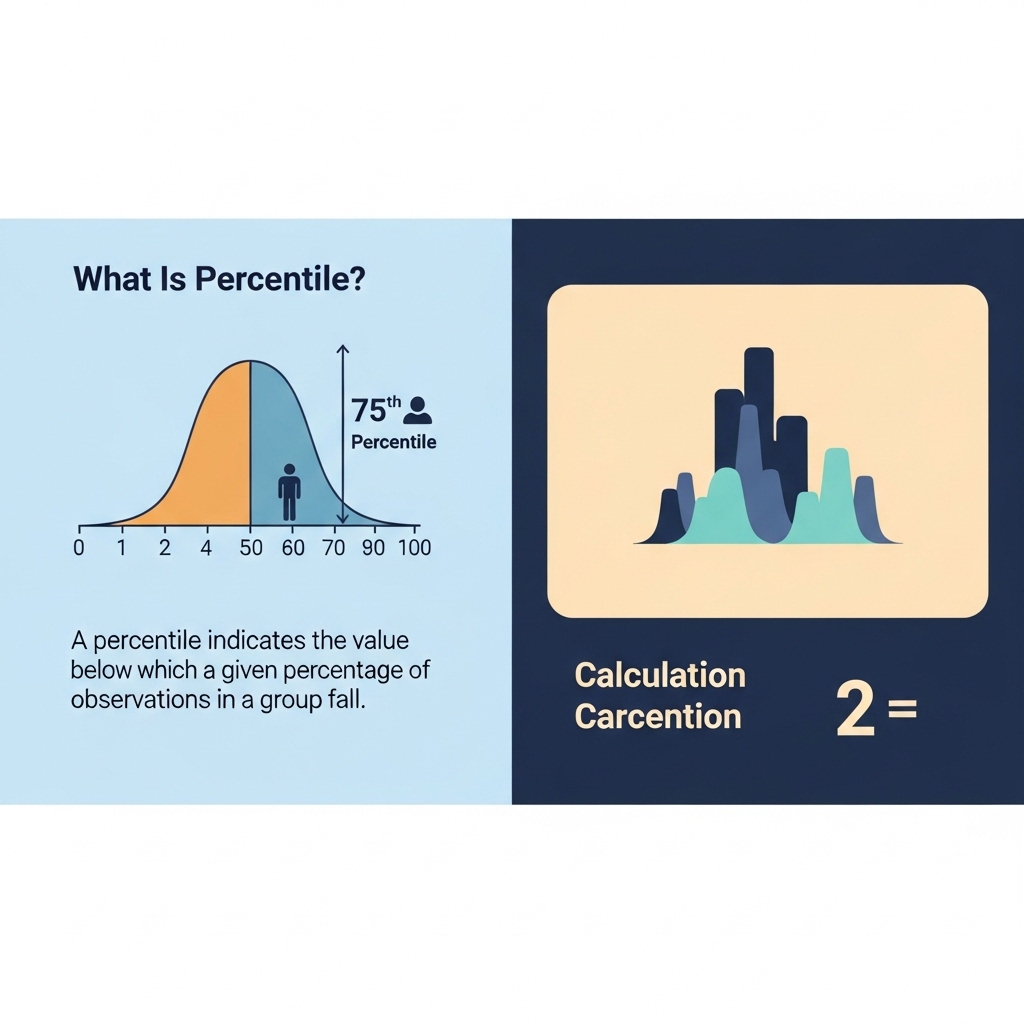
Percentiles are essential for understanding your position in a group. They answer the question: “How many people did I outperform?” rather than “How many questions did I answer correctly?” This makes percentiles particularly valuable in competitive exams where the difficulty level varies from year to year, and raw scores alone do not provide meaningful comparisons.
Percentile Formula (For a Given Score):Percentile Rank = (Number of values below the score ÷ Total number of values) × 100
Step-by-Step Percentile Calculation:
First, arrange all scores in ascending order from lowest to highest. Second, count how many scores fall below your specific score. Third, divide that count by the total number of scores in the dataset. Fourth, multiply the result by 100 to get your percentile rank.
Real-World Example of Percentile Calculation:
Suppose 100 students take an exam. Your score is 85. When you arrange all scores in order, you find that 90 students scored below 85. Your percentile rank would be (90 ÷ 100) × 100 = 90th percentile. This means you scored higher than 90% of the students.
Now consider a different scenario. Suppose the same exam was extremely difficult, and you scored only 65. If 95 students scored below 65, your percentile rank would be (95 ÷ 100) × 100 = 95th percentile. Despite scoring only 65%, you performed better than 95% of test-takers because the exam was challenging for everyone.
This example illustrates the crucial difference between percentage and percentile. A low percentage does not necessarily mean poor performance relative to peers. Conversely, a high percentage does not guarantee a high percentile if many other students scored even higher.
Common Percentile Benchmarks:
- 90th percentile: You scored higher than 90% of the group
- 75th percentile (third quartile): You scored higher than 75% of the group
- 50th percentile (median): You scored higher than 50% of the group
- 25th percentile (first quartile): You scored higher than 25% of the group
Key Differences Between Percentage and Percentile
| Aspect | Percentage | Percentile |
|---|---|---|
| Definition | A number expressed as a fraction of 100 | A measure of relative standing within a group |
| What It Answers | How many out of 100 did I get right? | What percentage of people scored below me? |
| Calculation | (Obtained ÷ Total) × 100 | (Number below ÷ Total) × 100 |
| Range | 0 to 100 (can exceed 100) | 0 to 100 (cannot exceed 100) |
| Independence | Independent of others’ performance | Dependent on others’ performance |
| Use Case | Grading, discounts, interest rates | Competitive exams, standardized tests |
| Interpretation | Absolute performance | Relative ranking |
The most important distinction to remember is that percentage measures absolute performance against a fixed standard, while percentile measures relative performance against a peer group. A 90% score is always 90 out of 100, regardless of who else took the test. But the 90th percentile changes depending on how well everyone else performed.
Why Percentile Matters More Than Percentage in Competitive Exams
In competitive exams like the SAT, GRE, GMAT, CAT, NEET, JEE, and UPSC, percentile scores are often more important than raw percentages. These exams are designed to rank candidates against each other rather than measure absolute knowledge against a fixed standard. Admission committees use percentiles to compare applicants who took different versions of the same exam in different years.
Consider the Graduate Record Examination (GRE). A raw score of 160 on the verbal section might translate to the 85th percentile one year and the 80th percentile the next year, depending on the difficulty of the test and the performance of the test-taking population. Graduate schools care about your percentile because it shows how you rank against other applicants, not just how many questions you answered correctly.
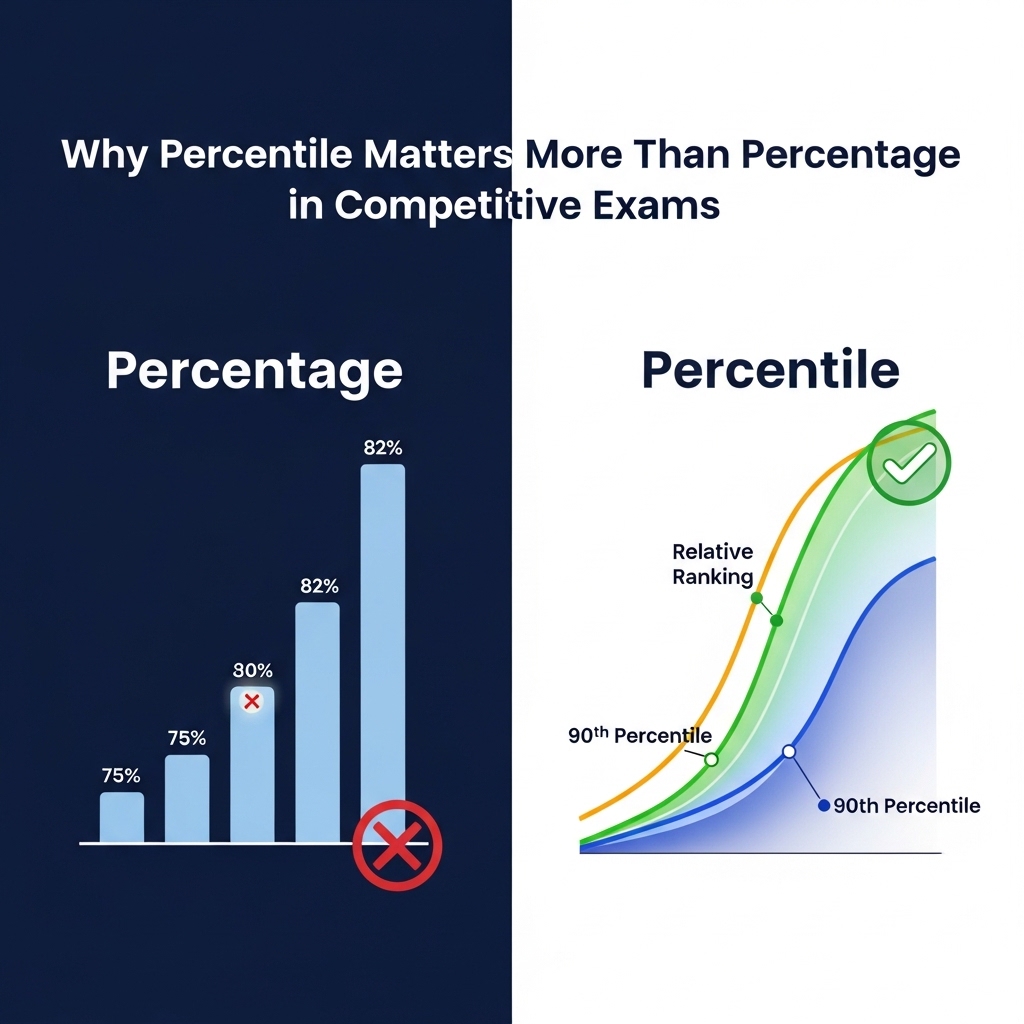
The Common Admission Test (CAT) for Indian business schools explicitly uses percentiles for shortlisting candidates. A candidate scoring 70% on the CAT might be at the 95th percentile if the exam was extremely difficult, while another candidate scoring 85% might only be at the 80th percentile if the exam was easy and many others scored higher. The percentile determines who gets interview calls, not the raw percentage.
Standardized tests like the SAT and ACT provide both a raw score and a percentile rank in score reports. The percentile rank helps students understand how they performed compared to other test-takers nationwide. A student in the 90th percentile can confidently apply to competitive universities, even if their raw percentage does not sound impressive by itself.
Medical entrance exams like NEET (National Eligibility cum Entrance Test) use percentiles to determine admission to medical colleges. With hundreds of thousands of applicants, the percentile rank determines your position in the merit list. A difference of one percentile point can mean the difference between admission to a top government medical college and no admission at all.
How Percentage and Percentile Are Used in Different Contexts
In Academic Grading:
Schools typically use percentages to assign letter grades. A student scoring 90% receives an A, 80% receives a B, and so on. These percentages are absolute measures based on the number of correct answers. Percentiles are rarely used in classroom grading because the goal is to measure mastery of content, not relative ranking against classmates.
In Standardized Testing:
Percentiles dominate standardized testing. The SAT, ACT, GRE, GMAT, LSAT, and MCAT all provide percentile ranks alongside raw scores. These percentiles allow colleges and graduate schools to compare students who took different test dates or even different versions of the same exam. A score of 1500 on the SAT might be at different percentiles depending on the test administration.
In Employment Testing:
Many employers use aptitude tests that report percentile scores. If you score at the 80th percentile on a mechanical reasoning test, it means you performed better than 80% of the norm group. Employers use these percentiles to identify candidates who have strong abilities relative to the general population or relative to other applicants.
In Medical and Child Development:
Doctors use percentiles to track child growth. If a two-year-old boy is at the 75th percentile for height, it means he is taller than 75% of two-year-old boys his age. This helps pediatricians identify potential growth issues early. Percentages would be meaningless in this context because there is no absolute “total height” to measure against.
In Financial Analysis:
Percentages are far more common than percentiles in finance. Interest rates, return on investment, profit margins, and tax rates are all expressed as percentages. Percentiles are occasionally used in risk management and portfolio performance evaluation, but percentage remains the dominant metric.
Common Mistakes Students Make With Percentage and Percentile
Confusing percentage with percentile is the most common and costly mistake. Students often say “I scored in the 90th percentage” when they mean “90th percentile.” This error can confuse admissions officers and demonstrates a lack of understanding of basic statistics. Always say “percentile” when referring to relative rank and “percentage” when referring to absolute proportion.
Assuming a high percentage guarantees a high percentile is another frequent error. On an easy exam, many students may score 90% or higher, pushing the 90th percentile to 95% or above. Your 90% might only be at the 50th percentile if half the class scored above 90%. Percentage alone tells you nothing about your ranking.
Believing that percentile scores can exceed 100 is mathematically impossible. Percentiles range from 0 to 100, where the 100th percentile would mean scoring higher than 100% of the group — which is impossible because you cannot score higher than yourself. Some test reports cap the 99th percentile as the maximum possible.
Using the wrong formula for percentile calculation is common among students attempting to compute their own percentiles. Remember that percentile rank equals (number of scores below yours ÷ total scores) × 100, not (your score ÷ total possible score) × 100. The latter formula gives percentage, not percentile.
Misinterpreting low percentiles as failing grades is a misunderstanding of what percentiles represent. Being at the 20th percentile does not mean you scored 20%. It means 80% of the group scored higher than you. On a difficult exam, a 20th percentile score might still be 70% or higher. Percentile measures ranking, not correctness.
Percentage vs. Percentile: Real Exam Scenarios
Scenario 1: The Easy Exam
An exam has 100 questions, each worth 1 mark. The exam is very easy. You score 85 correct answers, giving you 85%. However, 70% of all test-takers scored 90 or higher. Your percentile rank is only 30th because you performed better than only 30% of the group. Despite a respectable 85%, you rank near the bottom.
Scenario 2: The Difficult Exam
The same exam is made extremely difficult. The average score is only 40 out of 100. You score 55 correct answers, giving you 55%. This sounds much worse than 85%. However, only 10% of test-takers scored above 55. Your percentile rank is 90th because you performed better than 90% of the group. Your lower percentage actually represents superior performance relative to peers.
Scenario 3: Competitive Admissions
Two students apply to the same university. Student A scored 92% on an easy national exam and is at the 75th percentile. Student B scored 78% on a notoriously difficult exam and is at the 95th percentile. Despite having a lower percentage, Student B is more competitive for admission because they outperformed 95% of their peer group, demonstrating exceptional ability relative to a challenging assessment.
Scenario 4: Year-to-Year Variation
The same standardized test is administered in 2024 and 2025. In 2024, a raw score of 130 corresponds to the 85th percentile. In 2025, the test is easier, and a raw score of 130 corresponds to only the 75th percentile. A student who scored 130 in 2025 cannot compare their raw score directly to the 2024 student. They must compare percentiles to understand relative standing.
How to Convert Percentage to Percentile (And Why You Usually Cannot)
The critical truth is that you cannot directly convert a percentage to a percentile without knowing the distribution of scores. A percentage of 80% might be at the 90th percentile on a difficult exam, the 50th percentile on an average exam, or the 10th percentile on an extremely easy exam. The conversion depends entirely on how other test-takers performed.
Some standardized tests publish conversion tables that show how raw scores (which can be expressed as percentages) map to percentiles. For example, the SAT releases annual percentile tables showing that a math score of 700 (approximately 78% raw percentage) corresponds to the 90th percentile. These tables are specific to each test administration and cannot be generalized.
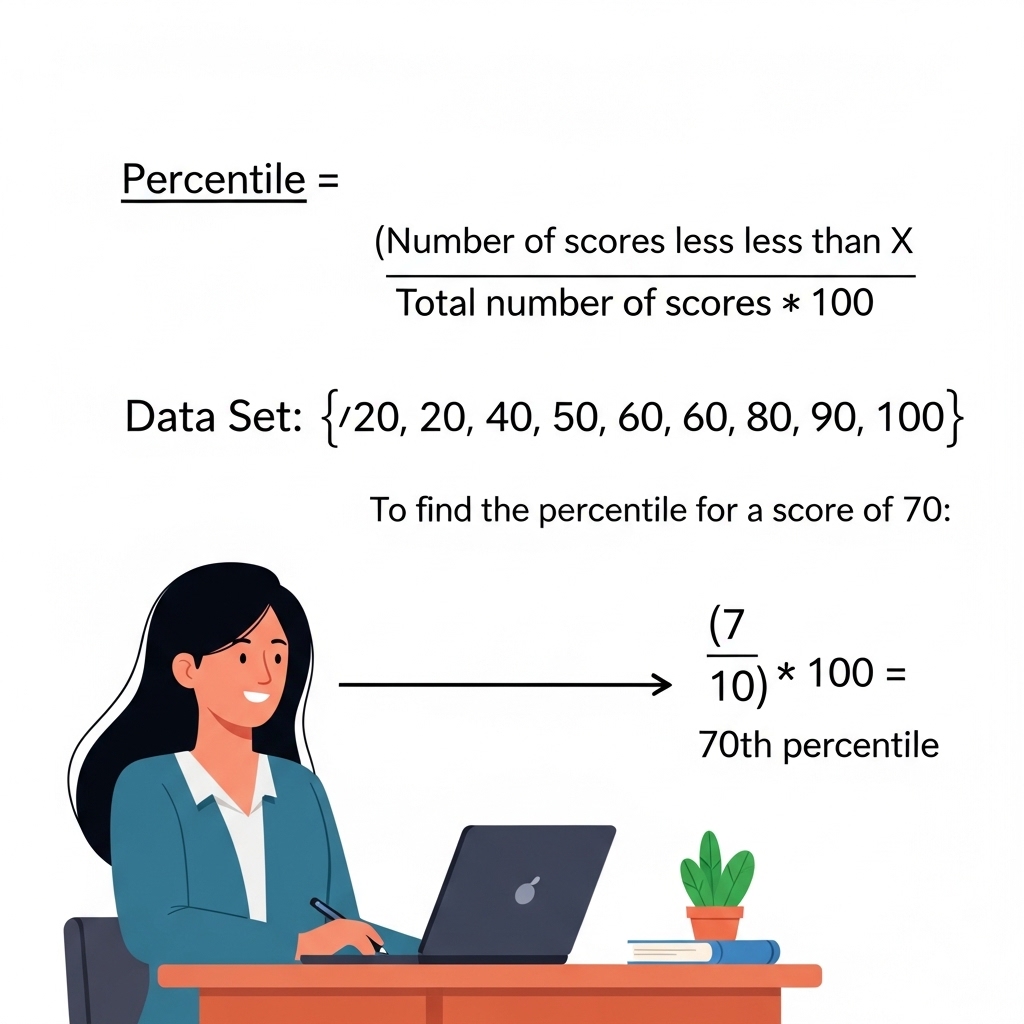
For classroom assessments, you can calculate percentiles if you have access to the full distribution of scores. Arrange all student scores from lowest to highest. Find your score. Count how many students scored below you. Divide by the total number of students. Multiply by 100. This gives your percentile rank within that specific class.
Online percentile calculators are available, but they require you to input the full dataset or at least the mean and standard deviation of scores. Without knowing how others performed, any claimed conversion from percentage to percentile is mathematically invalid. Be skeptical of any website that promises to convert your percentage to a percentile without additional data.
Expert Tips for Interpreting Percentage and Percentile
Always check whether a score report provides percentage or percentile before drawing conclusions. Standardized tests typically provide both, but some reports emphasize one over the other. Read the fine print and understand exactly what each number represents before celebrating or worrying about your performance.
When comparing scores across different years or different versions of an exam, always use percentiles rather than raw percentages. Percentiles adjust for variations in difficulty and test-taker ability. A 90th percentile in 2024 is directly comparable to a 90th percentile in 2025, even if the underlying raw scores are different.
For college applications, research whether the institution emphasizes percentage or percentile. Most US universities focus on percentiles for standardized tests like the SAT and ACT but use percentages for high school grades. International students should understand the grading norms of their target country.
When preparing for competitive exams, focus on improving your percentile rather than chasing a specific raw percentage. Because exam difficulty varies, aiming for a certain percentage may be unrealistic or insufficient. Instead, aim to outperform a certain percentage of test-takers, which is the metric that actually determines admission.
Use percentile information to set realistic goals. If you are currently at the 40th percentile, aiming for the 90th percentile in one month may be unrealistic. Focus on incremental improvements: 40th to 55th to 70th percentile over multiple attempts. Percentile gains become progressively harder as you climb higher.
Frequently Asked Questions (FAQs)
Q1: What is the main difference between percentage and percentile?
Percentage measures absolute performance as a fraction of 100, while percentile measures relative standing compared to a group. Percentage is independent of others’ performance; percentile depends entirely on how others performed.
Q2: Can percentile be higher than percentage?
Yes. On a difficult exam, a student might score 55% but be at the 90th percentile because 90% of test-takers scored below 55%. Percentile and percentage are independent measures that cannot be directly compared.
Q3: Is 99th percentile good?
Yes, the 99th percentile is excellent. It means you scored higher than 99% of the test-taking population. Only 1% of test-takers scored higher than you. This is the highest percentile typically reported.
Q4: What does 1st percentile mean?
The 1st percentile means you scored higher than only 1% of the group. This indicates that 99% of test-takers scored higher than you. It represents very low relative performance.
Q5: How do I calculate my percentile rank in class?
Arrange all student scores in ascending order. Count how many students scored below you. Divide that number by the total number of students. Multiply by 100. This gives your percentile rank within that specific class.
Q6: Can percentage ever equal percentile?
Yes, but only in very specific and coincidental circumstances. For example, if you score 75% on an exam and exactly 75% of test-takers scored below you, then your percentage equals your percentile. This is rare and not mathematically guaranteed.
Q7: Do universities care more about percentage or percentile?
For standardized tests (SAT, ACT, GRE, GMAT), universities care about percentiles. For high school grades, they care about percentages (or letter grades). Always check the specific requirements of each institution.
Q8: What is a good percentile on the SAT?
The 90th percentile or higher is considered excellent on the SAT. The 75th percentile is considered above average. The 50th percentile is exactly average. Competitive universities typically expect percentiles in the 90s.
Q9: Why do some exams only report percentiles?
Exams like the CAT and NEET report only percentiles because raw scores are meaningless for comparison. With hundreds of thousands of test-takers and varying difficulty levels, percentiles provide a fair and standardized ranking system for admissions.
Q10: Can I convert my percentage to percentile for job applications?
No, you cannot convert percentage to percentile without knowing the distribution of scores for your specific exam. If a job application asks for percentile, you must obtain that information from the official score report of the standardized test you took.
Comparison Table: Percentage vs. Percentile at a Glance
| Feature | Percentage | Percentile |
|---|---|---|
| Full Meaning | Per hundred | Relative rank out of 100 |
| Formula | (Part ÷ Whole) × 100 | (Number below ÷ Total) × 100 |
| Range | 0 to 100 (can exceed 100) | 0 to 100 (cannot exceed 100) |
| Depends on Others? | No | Yes |
| Use in Grading | Letter grades | Class rank |
| Use in Standardized Tests | Raw score | Competitive ranking |
| Use in Finance | Interest, discounts, returns | Risk assessment |
| Use in Medicine | Dosages, concentrations | Growth charts |
| Interpretation | Absolute performance | Relative standing |
| Example | Scored 80 out of 100 = 80% | Scored better than 85% of test-takers = 85th percentile |
Conclusion
Understanding the difference between percentage and percentile is essential for accurate interpretation of academic scores, competitive exam results, and professional assessments. Percentage measures your absolute performance against a fixed standard, answering the question of how many out of 100 you got right. Percentile measures your relative standing within a group, answering the question of what percentage of people scored below you.


