Understanding how to calculate and interpret academic grading metrics is essential for college admissions, scholarship applications, and long-term career planning.
CGPA, OGPA, SGPA, and GPA are the four most common terms students encounter on transcripts and university portals, yet confusion about their differences remains widespread.
This comprehensive guide simplifies every aspect of these grading systems with step-by-step methods, real-world examples, comparison tables, and expert tips to help you navigate your academic journey with confidence.
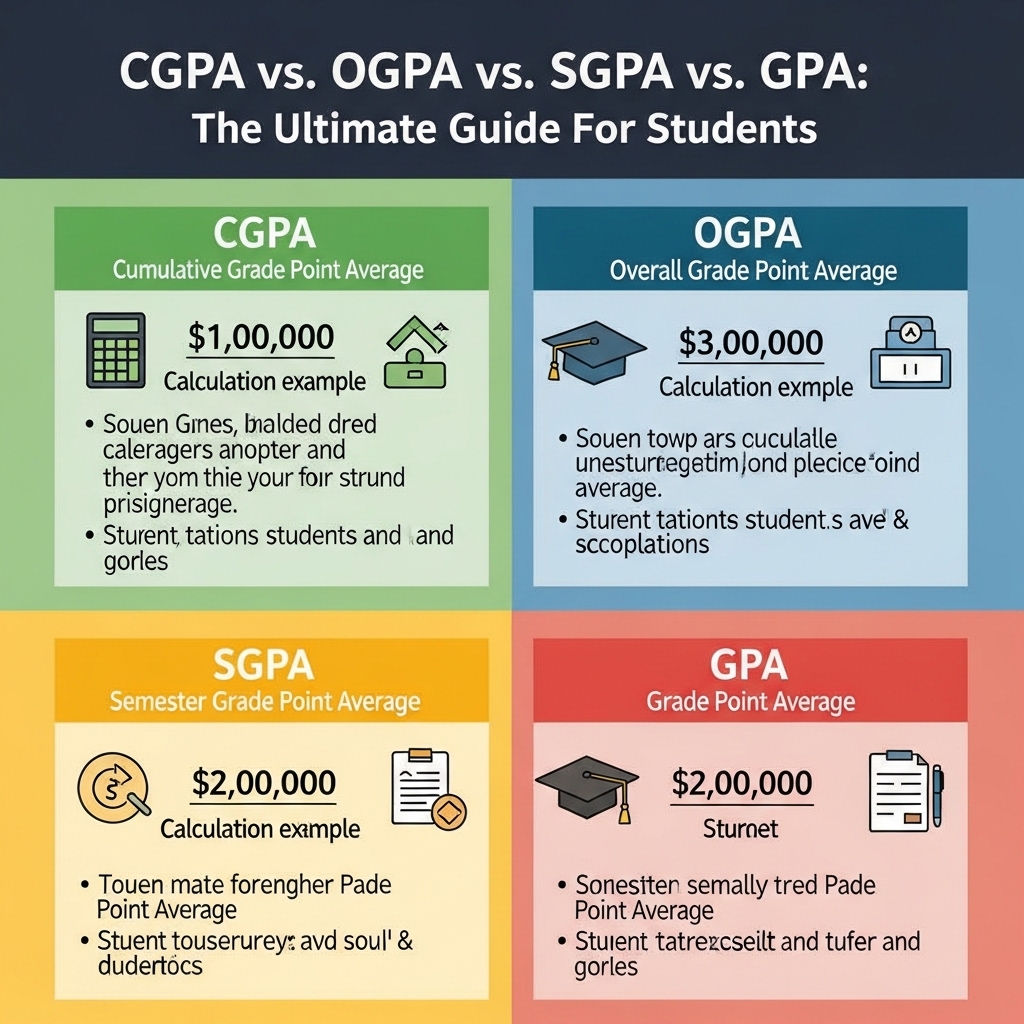
GPA (Grade Point Average) is the foundation of most academic evaluation systems worldwide. SGPA (Semester Grade Point Average) focuses specifically on one term’s performance, while CGPA (Cumulative Grade Point Average) aggregates performance across multiple semesters.
OGPA (Overall Grade Point Average) is the most comprehensive metric, including every course attempt — even failures and retakes — providing a complete academic history.
Each of these metrics serves a distinct purpose. Some are used for semester-by-semester tracking, while others determine degree classifications, graduate school admissions, or professional licensing eligibility.
By the end of this guide, you will not only understand the differences but also know exactly which metric matters most for your specific situation, whether you are applying to college, seeking a scholarship, or preparing for graduate school.
What Is GPA and Why It Matters
GPA stands for Grade Point Average, a numerical representation of a student’s academic performance over a specific period. Most high schools and universities calculate GPA on a 4.0 scale, although some institutions use weighted systems that account for course difficulty. The GPA is typically reset at the beginning of each semester or academic year, making it a short-term indicator of performance.
The importance of GPA cannot be overstated. College admissions committees use GPA as a primary filter for applicants. Scholarship organizations set minimum GPA thresholds for eligibility. Even employers, particularly for entry-level positions and internships, often request GPA information to assess a candidate’s discipline and work ethic.
There are two main types of GPA: unweighted and weighted. Unweighted GPA uses a standard 4.0 scale for all courses, meaning an A in physical education equals the same 4.0 as an A in advanced calculus. Weighted GPA, on the other hand, gives extra points for honors, AP, or IB courses, allowing GPAs to exceed 4.0 and better reflecting academic rigor.
Why GPA is important for students:
- College admissions decisions and ranking
- Scholarship eligibility and renewal
- Academic honors such as Dean’s List and cum laude
- Internship and entry-level job opportunities
- Graduate school applications
Understanding GPA calculation is the first step toward academic success. A strong GPA signals consistency, discipline, and mastery of subject matter. It remains one of the first factors admissions officers evaluate when comparing candidates from different schools and backgrounds.
How to Calculate GPA Step by Step
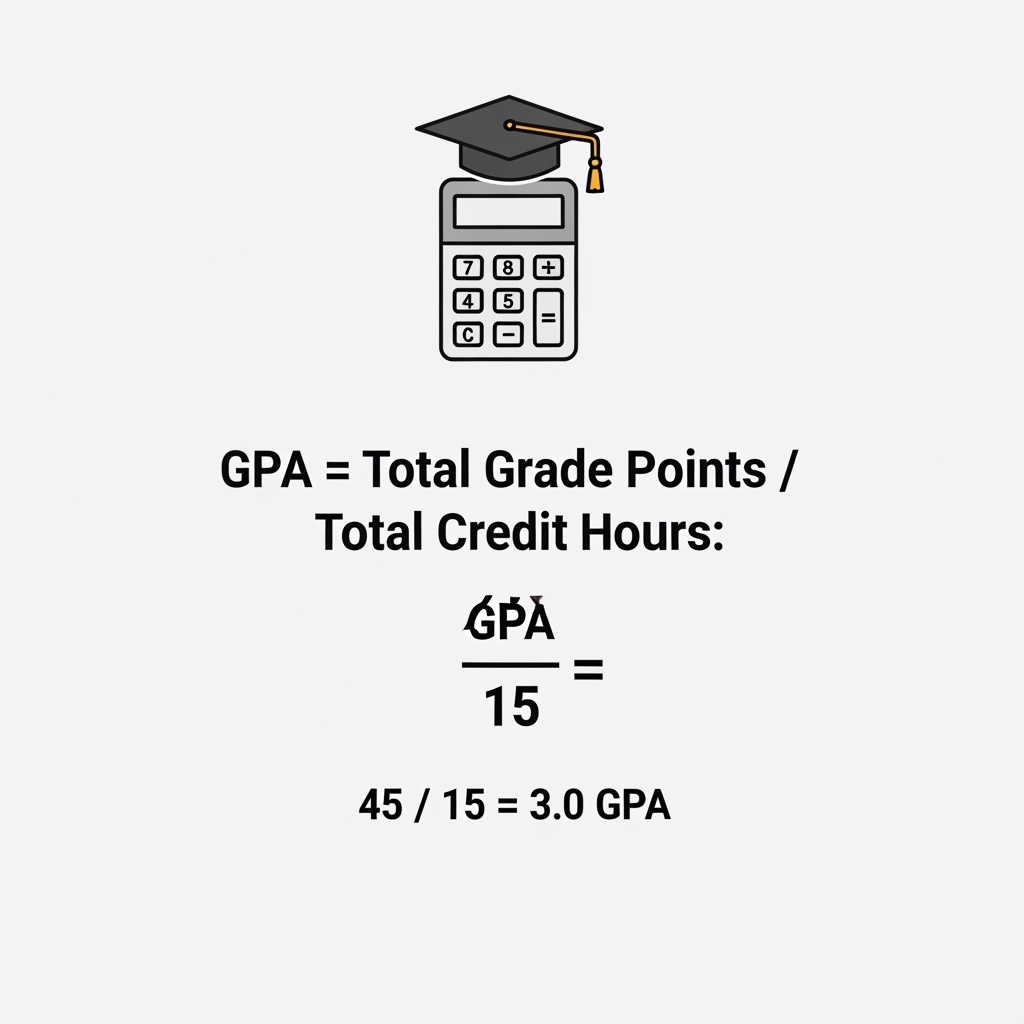
Calculating GPA follows a simple four-step process that works for both high school and college settings. First, convert each letter grade to its corresponding numerical point value using your institution’s official scale. Second, if your school uses credit hours, multiply each course’s grade points by its credit value. Third, add all grade points together to get your total points earned. Fourth, divide that total by the number of courses or total credit hours.
Example 1: Simple GPA Calculation (Unweighted, No Credits)
| Subject | Grade | GPA Points |
|---|---|---|
| Mathematics | A | 4.0 |
| English | B | 3.0 |
| Science | A | 4.0 |
| History | C | 2.0 |
Total GPA Points = 4.0 + 3.0 + 4.0 + 2.0 = 13.0
Number of Subjects = 4
GPA = 13.0 ÷ 4 = 3.25
Example 2: GPA Calculation with Credit Hours
| Subject | Grade | GPA Points | Credits | Total Points |
|---|---|---|---|---|
| Mathematics | A | 4.0 | 4 | 16.0 |
| English | B | 3.0 | 3 | 9.0 |
| Science | A | 4.0 | 4 | 16.0 |
| History | C | 2.0 | 3 | 6.0 |
Total Points = 16.0 + 9.0 + 16.0 + 6.0 = 47.0
Total Credits = 4 + 3 + 4 + 3 = 14
GPA = 47.0 ÷ 14 = 3.36
In weighted GPA systems, advanced courses receive additional points. An A in an AP course might be worth 5.0 instead of 4.0, while an A in an honors course might be 4.5. This allows students taking challenging coursework to achieve GPAs above 4.0, which can be particularly advantageous for competitive college applications.
What Is SGPA (Semester Grade Point Average)
SGPA stands for Semester Grade Point Average, and it is functionally identical to GPA in terms of calculation method. The only difference is that SGPA explicitly refers to performance within a single academic semester, whereas GPA can refer to any defined period including a quarter, trimester, or full academic year. Many universities use the terms GPA and SGPA interchangeably on official documents.
The SGPA calculation formula is straightforward: SGPA equals the sum of grade points multiplied by credit hours for all courses in a semester, divided by the total credit hours for that semester. Each semester produces its own independent SGPA, which does not carry over or combine with previous or future terms.
Real Example of SGPA Calculation:
A student’s third semester includes the following courses:
- Calculus I (4 credits): Grade A (4.0) → 16 grade points
- General Chemistry (3 credits): Grade B+ (3.3) → 9.9 grade points
- World Literature (3 credits): Grade A- (3.7) → 11.1 grade points
- Modern History (2 credits): Grade B (3.0) → 6.0 grade points
Total Grade Points = 16.0 + 9.9 + 11.1 + 6.0 = 43.0
Total Credits = 4 + 3 + 3 + 2 = 12
SGPA = 43.0 ÷ 12 = 3.58
SGPA is particularly useful for identifying semester-specific patterns in academic performance. A sudden drop in SGPA may signal a difficult course load or personal challenges that need addressing. A rising SGPA shows improvement and growth over time, which can be highlighted in college applications or graduate school personal statements.
Academic advisors frequently use SGPA to recommend interventions or academic support services. Students can set semester-by-semester goals based on their SGPA targets. However, employers and graduate schools rarely ask for SGPA directly, preferring instead to see cumulative metrics like CGPA or OGPA.
What Is CGPA (Cumulative Grade Point Average)
CGPA stands for Cumulative Grade Point Average, and unlike GPA or SGPA, it does not reset each semester. Instead, CGPA accumulates all completed semesters into one sustained average that represents your long-term academic performance. This makes CGPA the most commonly requested metric for college admissions, scholarship renewals, and graduate school applications.
The cumulative nature of CGPA has important implications for students. One bad semester will lower your CGPA but will not destroy it entirely because the bad grades are averaged with many other semesters. Conversely, one excellent semester will raise your CGPA only slightly, as its impact is diluted by previous terms. This design rewards consistency over time and prevents a single semester from defining your entire academic record.
CGPA Calculation Formula:
CGPA = (SGPA₁ × Credits₁) + (SGPA₂ × Credits₂) + ... ÷ Total Credits
Alternatively, you can calculate CGPA directly from all courses:CGPA = Total Grade Points from All Semesters ÷ Total Credits from All Semesters
Example of CGPA Calculation Over 3 Semesters:
| Semester | SGPA | Credits | SGPA × Credits |
|---|---|---|---|
| Semester 1 | 3.2 | 15 | 48.0 |
| Semester 2 | 3.5 | 16 | 56.0 |
| Semester 3 | 3.8 | 15 | 57.0 |
Sum of (SGPA × Credits) = 48.0 + 56.0 + 57.0 = 161.0
Total Credits = 15 + 16 + 15 = 46
CGPA = 161.0 ÷ 46 = 3.50
In many countries, particularly India, CGPA is measured on a 10-point scale rather than the 4.0 scale common in the United States. The standardized conversion from CGPA to percentage is typically: Percentage = CGPA × 9.5. For example, a CGPA of 8.4 on a 10-point scale equals approximately 79.8%. Different educational boards and universities may use slightly different multipliers, so always verify your institution’s specific conversion policy.
CGPA is also used for degree classification in the United Kingdom and other Commonwealth countries. A CGPA of 3.7 to 4.0 on the US 4.0 scale typically translates to First-Class Honours, while 3.3 to 3.69 corresponds to Upper Second-Class Honours (2:1). These classifications carry significant weight in graduate admissions and certain professions.
When CGPA is the most important metric:
- College and university admissions decisions
- Scholarship eligibility and renewal
- Graduate school applications (law, medicine, business)
- Professional licensing (engineering, accounting, nursing)
- Academic honors such as cum laude, magna cum laude
What Is OGPA (Overall Grade Point Average)
OGPA stands for Overall Grade Point Average, and it is the most comprehensive and unforgiving academic metric available. Unlike CGPA, which may allow grade replacement or forgiveness for retaken courses, OGPA includes every single course attempt in your entire academic history. This includes failed courses, withdrawn courses, incomplete courses, and retaken courses — all of them count toward your OGPA.
The key difference between CGPA and OGPA lies in how repeated courses are handled. Many universities have grade forgiveness policies that allow a retaken course to replace the original failing grade in CGPA calculations. OGPA, however, typically has no such forgiveness. Both the original failure and the successful retake remain on your record and factor into the average.
OGPA Calculation Formula:
OGPA = Total Grade Points from All Attempted Courses ÷ Total Credits from All Attempted Courses
The crucial phrase here is “All Attempted Courses.” This means every course you have ever enrolled in, regardless of whether you passed, failed, withdrew, or later repeated it, contributes to your OGPA. For students who have retaken multiple courses, the difference between CGPA and OGPA can be dramatic.
Example Showing CGPA vs. OGPA Difference:
A student takes Calculus I and fails with a 0.0 grade point value for 4 credits. The student then retakes Calculus I and earns an A (4.0) for the same 4 credits. Additionally, the student completes five other courses with a 3.5 GPA across 16 credits.
CGPA Calculation (with grade replacement):
Only the A is counted: 4.0 × 4 = 16 points
Other courses: 3.5 × 16 = 56 points
Total points = 72, total credits = 20
CGPA = 72 ÷ 20 = 3.60
OGPA Calculation (both attempts counted):
First attempt failure: 0.0 × 4 = 0 points
Second attempt success: 4.0 × 4 = 16 points
Other courses: 3.5 × 16 = 56 points
Total points = 72, total credits = 24
OGPA = 72 ÷ 24 = 3.00
The difference is substantial: a 3.60 CGPA versus a 3.00 OGPA. This explains why certain professional programs and graduate schools require OGPA rather than institutional CGPA. They want to see your complete academic history, including your struggles and how you overcame them.
Who Uses OGPA and Why:
Medical school applications processed through AMCAS (American Medical College Application Service) require all course attempts, including retakes. A retaken class does not replace the original grade in AMCAS calculations. Your OGPA is what matters for medical school admissions, not your undergraduate institution’s CGPA.
Law school applications processed through LSAC (Law School Admission Council) similarly calculate your OGPA from all transcripts. Grade forgiveness policies do not apply. Many pre-law students are surprised to discover that their LSAC-calculated OGPA is significantly lower than their institutional CGPA.
Some graduate programs and professional licensing boards also request OGPA. This is particularly common in clinical psychology, pharmacy, and veterinary medicine. Always check application requirements carefully to determine whether CGPA or OGPA will be used in your evaluation.
Key Differences Between CGPA, OGPA, SGPA, and GPA
| Metric | Full Form | Time Period Covered | Includes Retakes/Failures? | Typical Scale | Primary Use Case |
|---|---|---|---|---|---|
| GPA | Grade Point Average | One semester or course set | Varies by institution | 0–4.0 or 0–10 | Short-term performance |
| SGPA | Semester Grade Point Average | One specific semester | No | 0–4.0 or 0–10 | Term-wise tracking |
| CGPA | Cumulative Grade Point Average | Multiple semesters (may exclude some retakes) | Sometimes | 0–4.0 or 0–10 | Degree classification |
| OGPA | Overall Grade Point Average | Entire academic history (all attempts) | Yes | 0–4.0 or 0–10 | Professional admissions |
The most important distinction to remember is that GPA and SGPA are short-term metrics, CGPA is a long-term cumulative metric with possible grade forgiveness, and OGPA is a complete historical metric with no forgiveness. Each has its place in academic evaluation, and understanding which one your target institution uses is critical for accurate self-assessment.
How to Convert Between These Metrics
Converting SGPA to CGPA is the most common calculation students need to perform. If you have your SGPA for each completed semester, simply add all SGPAs together and divide by the number of semesters. For example, if your SGPAs over four semesters are 7.2, 7.8, 8.0, and 7.6, your CGPA is (7.2 + 7.8 + 8.0 + 7.6) ÷ 4 = 7.65.
Converting CGPA to percentage is common in India and other Asian countries. The standard formula is Percentage = CGPA × 9.5. This multiplier was determined by the Central Board of Secondary Education (CBSE) based on board exam data, but different universities may use different multipliers ranging from 9.0 to 10.0.
Converting between different scales requires careful attention. To convert a 10-point CGPA to a 4-point GPA, the approximate formula is: 4-point GPA = (10-point CGPA ÷ 10) × 4. For example, a CGPA of 8.0 on a 10-point scale equals approximately 3.2 on a 4-point scale. However, many universities have their own official conversion tables, so always verify with the specific institution.
Converting percentage to GPA depends on the grading scale used. A common approximation divides the percentage by 25. For example, 85% would be approximately 3.4 on a 4.0 scale. More accurate conversion tables are available from organizations like World Education Services (WES) and should be used for official applications.
Quick Conversion Reference Table:
| Percentage | GPA (4.0 Scale) | CGPA (10.0 Scale) |
|---|---|---|
| 90–100% | 4.0 | 9.0–10.0 |
| 80–89% | 3.0–3.7 | 8.0–8.9 |
| 70–79% | 2.0–3.0 | 7.0–7.9 |
| 60–69% | 1.0–2.0 | 6.0–6.9 |
| Below 60% | 0.0–1.0 | Below 6.0 |
International Grading Systems Compared
The United States primarily uses the 4.0 GPA scale, with weighted systems allowing scores above 4.0 for advanced coursework. American transcripts typically report both semester GPA and cumulative CGPA. Grade forgiveness policies vary by institution, with some allowing grade replacement and others averaging both attempts.
Canada follows a similar system but often uses a 4.33 scale, where an A+ may be worth 4.33. Canadian universities also frequently report percentages alongside GPA. The conversion between percentage and GPA varies by province and institution, making direct comparison challenging.
India predominantly uses a 10-point CGPA scale, particularly under the CBSE and many university systems. The conversion to percentage using the 9.5 multiplier is widely accepted. However, some Indian institutions still use percentage-based systems or letter grades, creating inconsistency across applications.
The United Kingdom uses degree classifications rather than GPA. First-Class Honours (typically 70% and above) is the highest achievement, followed by Upper Second-Class Honours (2:1, 60–69%), Lower Second-Class Honours (2:2, 50–59%), and Third-Class Honours (40–49%). Many UK universities now provide GPA equivalents for international applicants.
Germany uses a reverse 1 to 5 scale, where 1.0 is excellent and 5.0 is failing. This often confuses international students accustomed to higher numbers indicating better performance. Conversion tables between German grades and US GPA are available through organizations like Anabin.
Australia uses a variety of GPA scales depending on the university. Some use a 4.0 scale, others a 7.0 scale, and still others use percentages or letter grades. The Australian Tertiary Admission Rank (ATAR) is used for university admissions, but GPA is used for ongoing academic evaluation.
Common Mistakes Students Make With GPA Calculations
Mixing weighted and unweighted GPA is one of the most frequent errors students make. When a student reports a 4.2 weighted GPA alongside a 3.6 unweighted GPA without clarification, admissions officers cannot determine which scale applies. Always specify whether your GPA is weighted or unweighted on applications.
Ignoring credit hours leads to inaccurate calculations. A B in a 4-credit course affects your GPA much more than an A in a 1-credit lab. Students who simply average their letter grades without weighting by credits often miscalculate their true GPA significantly.
Using incorrect grade scales is another common pitfall. Different high schools use different conversion tables. Some treat an A- as 3.7, while others treat it as 3.67 or even 3.5. Always use your specific institution’s official grade conversion scale rather than generic online tables.
Rounding too early distorts final calculations. If you round each course’s grade points to one decimal place before multiplying by credits, your final GPA may be off by 0.05 or more. Perform all calculations with full precision and round only the final result.
Assuming CGPA and OGPA are identical is a dangerous mistake, particularly for pre-med and pre-law students. Your university’s CGPA may include grade forgiveness that professional school applications will ignore. Always calculate your OGPA separately when applying to programs that require it.
Forgetting to include failed courses in CGPA calculations is common but incorrect. Unless your institution has a specific grade forgiveness policy, failed courses remain in your CGPA and lower your average. Some students mistakenly believe that retaking a course automatically erases the original grade, which is not true at many universities.
Expert Tips to Improve Your CGPA and OGPA
Focus on high-credit subjects first and foremost. A 4-credit course has four times the impact on your GPA as a 1-credit course. Spending extra time to raise a B to an A in a high-credit course improves your GPA more than earning perfect scores in multiple low-credit electives.
Take advanced courses strategically. Weighted GPA systems reward honors, AP, and IB courses with extra points. Even if you earn a B in an AP course, your weighted GPA may be higher than an A in a regular course. This strategy works best when you are confident you can perform adequately in advanced coursework.
Retake failed courses when your institution allows grade replacement. If your university replaces the original F with the new grade (rather than averaging both), retaking a failed course can dramatically improve both your CGPA and OGPA. However, verify the policy first — some institutions average both attempts, which helps less.
Track your progress every semester rather than waiting until graduation. Calculating your SGPA and CGPA after each term allows you to identify problems early. If your SGPA drops below your target, you can adjust your study habits or course load before the damage affects your CGPA irreversibly.
Use AI-powered GPA calculators and academic planning tools. Modern technology can instantly compute your current GPA, project future GPAs based on expected grades, and show you exactly what grades you need in remaining courses to reach your target CGPA. This removes guesswork and keeps you focused on achievable goals.
Seek grade forgiveness or academic renewal policies if your institution offers them. Some universities allow students to petition to have past poor grades excluded from CGPA calculations after demonstrating improved performance. These policies vary widely, but they can be lifesaving for students who struggled early in their academic careers.
Best Strategies to Maintain a High CGPA Long Term
Plan your course load strategically across all semesters. Avoid clustering all difficult courses in a single semester, which can lead to burnout and low SGPA. Instead, balance challenging advanced courses with manageable electives to maintain consistent performance throughout your academic career.
Identify your weak areas early and address them immediately. If you struggle with mathematics, take advantage of tutoring centers, study groups, and office hours before your grades suffer. Early intervention is far more effective than trying to recover from a failing grade later in the semester.
Complete all assignments on time and never skip low-stakes assessments. Homework, quizzes, and participation points may seem insignificant individually, but collectively they can raise or lower your final grade by a full letter. Students who neglect small assignments often find themselves needing unrealistic scores on final exams.
Revise regularly rather than cramming before exams. Spaced repetition and consistent study habits produce higher retention and better exam performance than last-minute cramming. Your CGPA reflects long-term mastery of subject matter, not just your ability to memorize information the night before a test.
Use GPA calculators for tracking and projection. Enter your current grades and credits into a GPA calculator to see your exact standing. Then experiment with different grade scenarios to understand what you need to achieve in remaining courses to reach your target CGPA.
Stay healthy and manage stress effectively. Academic performance suffers when students neglect sleep, nutrition, and exercise. A sustainable routine that includes proper self-care will produce better long-term results than short bursts of intense, unsustainable effort.
Frequently Asked Questions (FAQs)
Q1: Is CGPA the same as GPA?
No. GPA measures performance over a single semester or short period, while CGPA measures cumulative performance across multiple semesters. GPA resets each term; CGPA does not.
Q2: Can OGPA be lower than CGPA?
Yes, significantly lower in many cases. OGPA includes all course attempts, including failures and retakes, while CGPA may exclude or replace them through grade forgiveness policies.
Q3: Which is more important for college admissions: CGPA or OGPA?
Most undergraduate college admissions prioritize CGPA. However, graduate and professional programs (especially medical and law schools) often require OGPA calculated by centralized application services.
Q4: How do I convert SGPA to CGPA?
Add all your semester SGPAs together and divide by the number of semesters completed. For weighted calculations, multiply each SGPA by the semester’s credit hours before summing and dividing.
Q5: What is a good CGPA on a 4.0 scale?
A CGPA of 3.5 or higher is considered excellent and competitive for top universities. A CGPA of 3.0 to 3.4 is considered good for most state universities. Below 2.0 may result in academic probation.
Q6: Do employers check OGPA?
Rarely. Most employers ask for CGPA or overall percentage. OGPA is typically used only by academic institutions, professional licensing boards, and competitive graduate programs.
Q7: How does grade forgiveness affect CGPA vs. OGPA?
Grade forgiveness policies typically replace a failing grade with a retaken grade in CGPA calculations. However, OGPA almost always includes both the original failure and the retake, making OGPA lower.
Q8: What is the difference between weighted and unweighted GPA?
Unweighted GPA uses a standard 4.0 scale for all courses. Weighted GPA gives extra points for honors, AP, or IB courses, allowing GPAs above 4.0 to reflect course difficulty.
Q9: How do I calculate my OGPA manually?
List every course you have ever attempted, including failures, withdrawals, and retakes. Multiply each grade point by its credit hours. Sum all points. Sum all credits attempted. Divide total points by total credits.
Q10: Which metric should I put on my resume?
Generally, list your CGPA rather than SGPA or OGPA, as CGPA is most commonly understood. If your CGPA is below 3.0, consider omitting it unless the job specifically requires GPA information.
Conclusion
Understanding the differences between CGPA, OGPA, SGPA, and GPA is essential for academic success and career advancement. GPA and SGPA help you track short-term performance semester by semester, while CGPA provides the long-term view that matters most for college admissions and degree classification. OGPA serves as the most comprehensive metric, including every course attempt for professional program applications.
Each metric has a specific purpose and audience. Undergraduate admissions committees focus primarily on CGPA. Medical and law schools require OGPA calculated by centralized services. Employers typically want CGPA or may not ask at all. Knowing which metric to emphasize — and how to calculate each accurately — gives you a significant advantage in competitive academic environments.
Use the formulas, examples, and conversion tables in this guide to calculate your own scores correctly. Avoid common mistakes like mixing weighted and unweighted scales, ignoring credit hours, or assuming CGPA equals OGPA. Regular tracking combined with smart study habits will keep your CGPA competitive throughout your academic career.
Whether you are applying to college, seeking scholarships, preparing for graduate school, or entering the job market, mastering these grading metrics empowers you to present your academic record in the best possible light. A well-maintained CGPA — and an accurate understanding of your OGPA when required — not only improves your admission chances but also builds a strong foundation for lifelong academic and professional success.


