
Figuring out your high school GPA is really important for getting into college getting scholarships and doing well in school. Your GPA or Grade Point Average shows how well you are doing overall.
It is one of the things that colleges look at especially in the United States. A lot of students have trouble calculating their GPA because schools use grading systems some classes are weighted and they have different credit systems.
This guide will make it easy for you by showing you step by step how to do it with examples, tables and advice from experts so you can calculate your Grade Point Average accurately and feel good, about it.
What is GPA and Why It Matters
GPA stands for Grade Point Average, a numerical representation of your academic performance. High schools typically calculate GPA on a 4.0 scale, although some use weighted systems.
Why GPA is Important:
- College admissions decisions
- Scholarship eligibility
- Academic rankings
- Internship and job opportunities
A strong GPA signals consistency, discipline, and academic excellence.
Types of GPA in High School
1. Unweighted GPA (Standard Scale)
- Based on a 4.0 scale
- Does not consider course difficulty
| Grade | GPA |
|---|---|
| A (90–100) | 4.0 |
| B (80–89) | 3.0 |
| C (70–79) | 2.0 |
| D (60–69) | 1.0 |
| F (<60) | 0.0 |
2. Weighted GPA (Advanced Courses)
- Includes honors, AP, or IB classes
- Gives extra points for harder courses
| Grade | Regular | Honors | AP/IB |
|---|---|---|---|
| A | 4.0 | 4.5 | 5.0 |
| B | 3.0 | 3.5 | 4.0 |
| C | 2.0 | 2.5 | 3.0 |
👉 Weighted GPA can exceed 4.0, making it more competitive for college applications.
Basic GPA Formula
GPA = Total Grade Points ÷ Total Number of Courses
Step-by-Step Guide to Calculate GPA
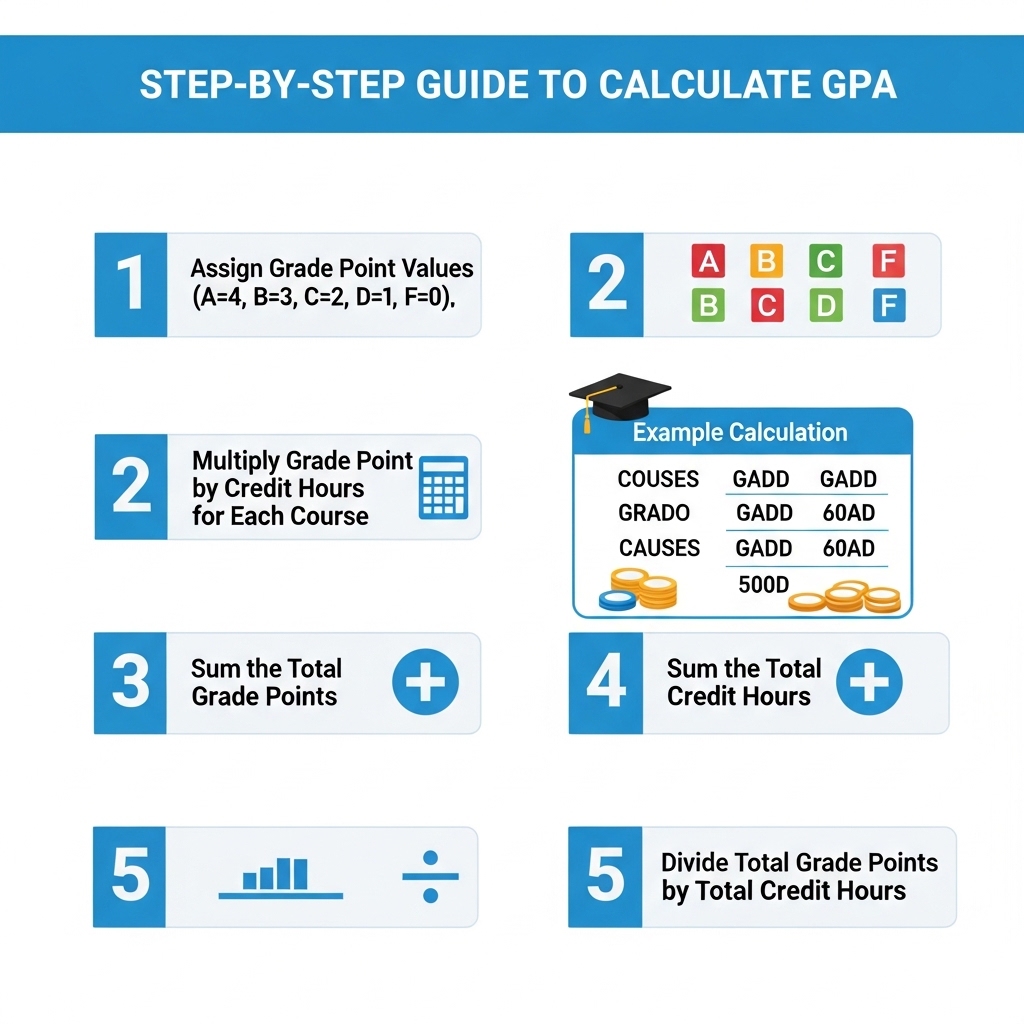
Step 1: Convert Grades to Points
Assign each grade a numerical value using the GPA scale.
Step 2: Multiply by Credits (if applicable)
Some schools assign credit hours to subjects.
Step 3: Add All Grade Points
Calculate total points earned.
Step 4: Divide by Total Courses or Credits
This gives your final GPA.
Example 1: Simple GPA Calculation (Unweighted)
| Subject | Grade | GPA Points |
|---|---|---|
| Math | A | 4.0 |
| English | B | 3.0 |
| Science | A | 4.0 |
| History | C | 2.0 |
👉 Total GPA Points = 13
👉 Number of Subjects = 4
GPA = 13 ÷ 4 = 3.25
Example 2: Weighted GPA Calculation
| Subject | Grade | Level | GPA Points |
|---|---|---|---|
| Math | A | AP | 5.0 |
| English | B | Honors | 3.5 |
| Science | A | Regular | 4.0 |
| History | B | Regular | 3.0 |
👉 Total Points = 15.5
👉 Subjects = 4
Weighted GPA = 15.5 ÷ 4 = 3.87
GPA Calculation with Credits (Advanced Method)
Some schools use credit hours for accuracy.
Example Table:
| Subject | Grade | GPA | Credits | Total Points |
|---|---|---|---|---|
| Math | A | 4.0 | 4 | 16 |
| Science | B | 3.0 | 3 | 9 |
| English | A | 4.0 | 3 | 12 |
👉 Total Points = 37
👉 Total Credits = 10
GPA = 37 ÷ 10 = 3.7
How GPA Systems Differ Internationally

USA System
- Uses 4.0 or weighted scale
- Most common system globally
Canada
- Similar to US but may use percentages
UK System
- Uses degree classifications instead of GPA
Australia
- Uses GPA but may vary between universities
👉 Always check conversion rules when applying internationally.
Common GPA Conversion Table (Global Reference)
| Percentage | GPA (4.0 Scale) |
|---|---|
| 90–100% | 4.0 |
| 80–89% | 3.0–3.7 |
| 70–79% | 2.0–3.0 |
| 60–69% | 1.0–2.0 |
AI Tools for GPA Calculation (Modern Method)
Artificial Intelligence has made GPA calculation easier than ever:
Benefits of AI GPA Tools:
- Instant calculations
- Error-free results
- Handles weighted and credit systems
- Provides performance insights
👉 Using AI tools saves time and improves accuracy significantly.
Common Mistakes Students Make
- Mixing weighted and unweighted GPA
- Ignoring credit hours
- Using incorrect grade scales
- Rounding too early
- Miscalculating total points
⚠️ Avoid these mistakes to ensure accurate GPA results.
Expert Tips to Improve Your GPA
1. Focus on High-Credit Subjects
Subjects with more credits impact GPA more.
2. Take Advanced Courses
AP and honors classes boost weighted GPA.
3. Stay Consistent
Regular performance matters more than one-time success.
4. Use Study Apps & AI Tools
Technology helps track and improve performance.
5. Track Progress Regularly
Calculate GPA after every semester.
Best Strategy to Maintain High GPA
Step-by-Step Plan:
- Plan subjects and study schedule
- Focus on weak areas
- Complete assignments on time
- Revise regularly
- Use GPA calculators for tracking
👉 Consistency + smart tools = high GPA.
FAQs (Optimized for Featured Snippets)
Q1: What is a good GPA in high school?
A GPA of 3.5 or higher is considered excellent and competitive for top colleges.
Q2: How do I calculate GPA from percentage?
Divide percentage by 25 (approximation) or use official conversion charts.
Q3: What is the difference between weighted and unweighted GPA?
Weighted GPA includes course difficulty, while unweighted does not.
Q4: Can GPA be higher than 4.0?
Yes, in weighted systems with AP or honors classes.
Q5: Do colleges prefer weighted GPA?
Yes, many colleges consider weighted GPA for evaluating academic rigor.
Conclusion
Calculating your GPA in school is super important for doing well in school and for your future.
To get your GPA you need to know the types of GPA how to calculate them and what formula to use.
This way you can keep track of how you’re doing in school.
You can use a method or a modern tool just make sure you do it the same way every time and get the numbers right.
Having a good GPA can help you get into a college and it also helps you do well in school.
GPA is really important, for your future so you should try to get an one and keep it up.
It will help you get into college. Do well in your studies.


